

The last nine weeks of the year are when people are most ready to give, buy, and commit. They are also when inboxes, feeds, and mailboxes are at their most crowded.
Whether you are a nonprofit looking to achieve your annual fundraising goal, or a business looking to close out the year strong, the same truth applies across the board: the organizations that plan early, tell a clear story, and show up consistently are the ones that win the season. The ones that wing it get lost in the noise.
Why year-end is different
For nonprofits, December is the month that makes or breaks the budget. The average nonprofit raises 37% of its annual online revenue in December (M+R Benchmarks). December 31 alone accounted for 4% of 2025 revenue (M+R Benchmarks). Donors are in a generous mindset, and the December 31 tax-deduction deadline gives them a built-in reason to act.
GivingTuesday kicks off the season on December 1, 2026. Last year, Americans gave $4.0 billion on that single day, up 13% from 2024 (GivingTuesday).
For businesses, the holiday season keeps getting bigger and starting earlier. Adobe forecasts U.S. online holiday sales of $275.1 billion from November 1 to December 31, 2026, up 6.7% from last year. Cyber Week, Thanksgiving (Nov. 26) through Cyber Monday (Nov. 30), is expected to bring in $47.5 billion of that. Adobe also expects October spending to rise 8%, a sign that shoppers start earlier every year (Adobe).
And it’s not only retail. B2B buyers often have budget to spend before year-end, and nearly every customer is open to a “thanks for a great year” or “start next year right” message.
While the goals differ - donations on one side, sales and loyalty on the other - the key elements of what makes a year-end campaign work are surprisingly similar.
Five things every winning year-end campaign shares
A clear deadline and a reason to act now. Urgency drives year-end results. For a nonprofit, that might be a GivingTuesday matching-gift challenge or the December 31 tax deadline. For a business, it is a limited-time offer, an early-access period for loyal customers, or a “book before January 1” incentive.
A story, not just an ask. People respond to what their money makes possible. In the 2025 Bank of America Study of Philanthropy, 93% of affluent households said they are more likely to give when they believe their gift will make a difference (Bank of America study via The Giving Institute). A nonprofit might tell one family’s story. A business might share a customer success story or a behind-the-scenes look at the year.
One message, every channel. Your email, social posts, paid ads, website, and direct mail should all tell the same story with the same look. Adobe expects social media and affiliate partners, including influencers, to see the biggest gains in share of holiday revenue this year (Adobe). Consistency is what makes a busy reader recognize you on the third touch.
The right message for the right person. A lapsed donor needs a different note than a monthly giver. A first-time buyer needs a different offer than your most loyal customer. Segmenting your lists also keeps you from sending “please give” reminders to people who already gave.
Gratitude and follow-through. The campaign does not end when the gift or sale comes in. A prompt, personal thank-you is the first step toward next year’s renewal, whether that person is a donor or a customer.
Quick playbooks: pick your lane
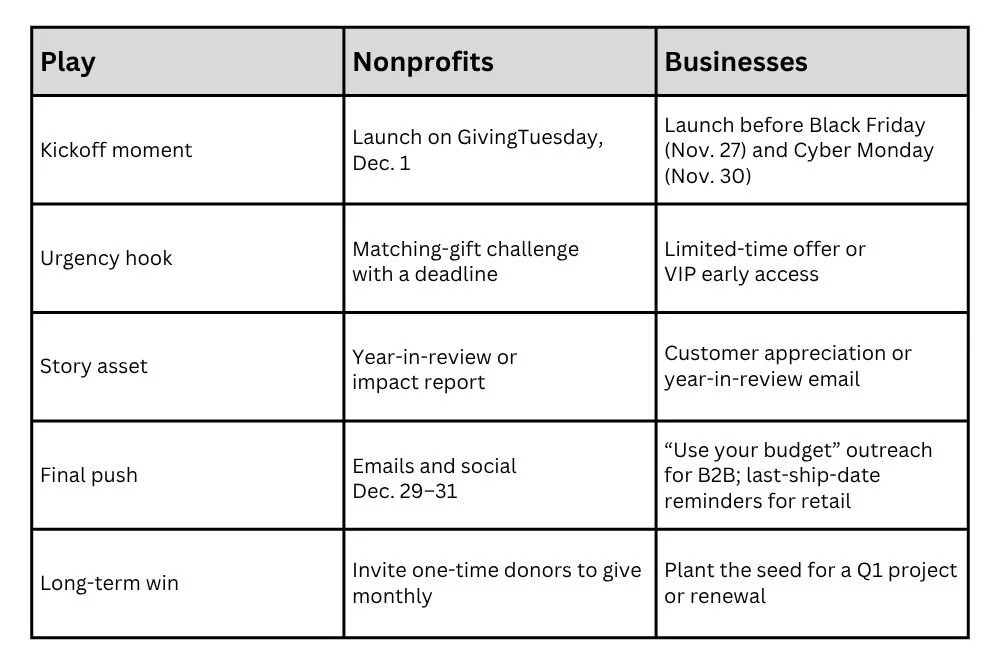
Year-end campaign playbook table comparing nonprofits and businesses.
(Note: These playbook samples are outlined in the graphic above. Text is provided below for accessibility purposes.)
Kickoff moment: nonprofits launch on GivingTuesday, Dec. 1; businesses launch before Black Friday (Nov. 27) and Cyber Monday (Nov. 30).
Urgency hook: nonprofits matching-gift challenge with a deadline vs. businesses limited-time offer or VIP early access.
Story asset: nonprofits year-in-review or impact report vs. businesses customer appreciation or year-in-review email.
Final push: nonprofits emails and social Dec. 29–31 vs. businesses “use your budget” outreach for B2B and last-ship-date reminders for retail.
Long-term win: nonprofits invite one-time donors to give monthly vs. businesses plant the seed for a Q1 project or renewal.
Two data points worth building around:
Monthly giving made up 27% of nonprofits’ online revenue in 2025, and 71% of new monthly donors were still giving a year later, compared with 24% retention for new one-time donors (M+R Benchmarks 2026). That makes a monthly-giving ask a natural fit for a year-end push.
On the retail side, Adobe expects Black Friday to grow faster than Cyber Monday this year, partly because it carries the deepest discounts in several categories (Adobe). Plan your offers accordingly.
Your year-end timeline: it’s not too late, but the clock is ticking
Now through early November: plan and build. Set a clear goal, choose the one story your campaign will tell, segment your lists, and produce the creative: emails, social graphics, ads, landing pages, and mail pieces.
Mid-November through early December: launch and peak. Businesses go live ahead of Black Friday (Nov. 27) and Cyber Monday (Nov. 30). Nonprofits warm up supporters in mid-November and launch publicly on GivingTuesday (Dec. 1). Watch results daily and shift budget toward what is working.
Mid to late December: the final push. Send deadline reminders, retarget people who showed interest, and lean into the last few days of the year, when giving spikes.
January: thank, report, retain. Send thank-yous, share results with your supporters or customers, and note what worked so next year starts ahead.
If you are reading this and haven’t started, the first step is the most important one: get the plan on paper this week.
Common mistakes to avoid
Starting too late. Shoppers now begin in October, and the best creative takes weeks, not days.
Sending everyone the same message. One generic blast is easy to ignore.
Going quiet after the big day. GivingTuesday and Cyber Monday are starting lines, not finish lines. Keep the conversation going.
Forgetting to ask. In GivingTuesday’s 2025 research, half of Americans said they didn’t recall being asked to give in both 2024 and 2025 (GivingTuesday GivingPulse). The same is true of your customers: if you don’t make the offer, they won’t take it.
Skipping the thank-you. It is the cheapest retention tool you have.
Not tracking results. If you don’t measure what worked this year, you are guessing next year. Save yourself the headache and track as you go.
How we help
Running a strong year-end campaign takes strategy, creative, email, ads, and reporting all working together, usually at the exact moment your team is busiest. That is where we come in.
Our full-service team handles the whole campaign under one roof, from the first planning session to the January results report, so your message stays consistent and your staff can focus on donors, customers, and the work itself.
Let’s make this your strongest finish yet
Whether you are raising funds for your mission or growing your business, the window to plan a great year-end campaign is open now, and it closes fast. Book a free, no obligation year-end strategy call with our team. In 30 minutes, we’ll look at your goals, your audience, and your calendar, and map out a campaign that’s ready in time for Black Friday and GivingTuesday.